
Design, Marketing
Don’t Spill All Your Candy In The Lobby
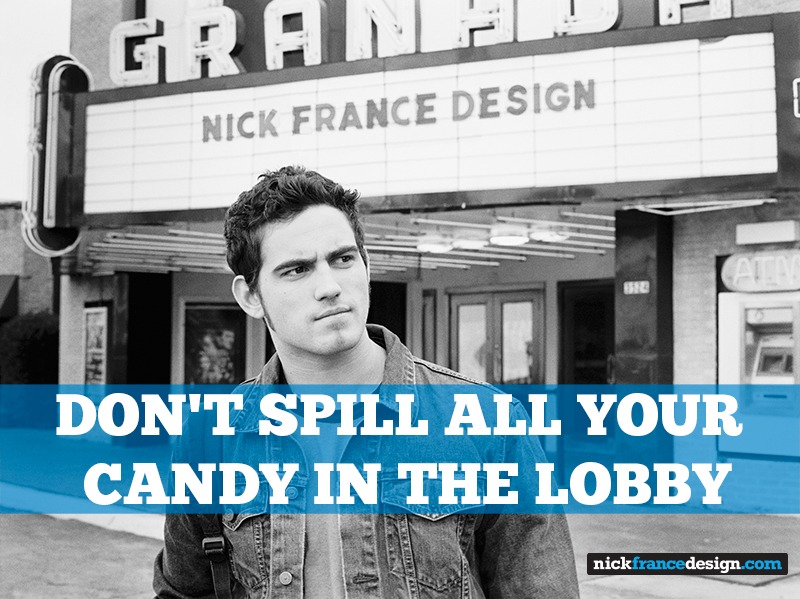
“ Don’t spill all your candy in the lobby" is a phrase I use often.
Some time ago, as I was reading a thread in a LinkedIn group for marketers, a question was posed: “What is your best marketing advice?” I replied, “Don’t spill all your candy in the lobby.” I did so because, in my view, many marketers were making this fundamental mistake when marketing products or services. They would, what I call, "spill all their candy in the lobby"–and frankly, it would drive me crazy. It makes me even crazier to be dragged into this process by a colleague or client. But it happens, and when it does, I go into my spiel about "spilling your candy in the lobby."
If you believe this is a marketing mistake as well, then my “don’t spill all your candy in the lobby” philosophy is for you. It is for me, and I’ve managed to convince many over the years.
Let me explain what I mean about this candy-spilling business. Quite a few years ago, I used to design newspaper ads. One day, as I was designing an ad, I began complaining about the excessive amount of copy. I didn't like the lack of white space. It didn't allow the ad's elements to flow and properly guide the reader's eye. Can you imagine that–a designer complaining about too much copy? Don, the media buyer, was listening to my rant. I felt that too much information was being divulged in the ad; it left nothing to the imagination. To me, this was a fundamental mistake.
Let the reader use their imagination
By leaving nothing to the imagination, or more specifically, providing all the information about the product, the potential buyer had no reason to call the number in the ad. He or she could decide whether to buy from the ad alone. This left the sales professional out of the equation. Why would you want an ad to close your deal when your sales department is more qualified? Again, in my view, this was a big mistake. That's not the job of the ad. I mean, the ad’s job was to provide just enough information to prompt the call to action. In those days, the web was not an option, so we had operators standing by to take your call. Well, sales professionals, anyway.
That’s when Don said, “Don’t spill all your candy in the lobby.” I knew exactly what Don was saying the second those words were uttered. Don and I shared many of the same beliefs about marketing. He knew exactly why providing every possible fact and figure about a product in an ad, mail piece–you name it–is not in your best interest.
Each component has a job. In those days, it was that ad’s job to make the phones ring. Today, it’s likely to prompt you to visit a website, send an email, comment, or share, but rest assured, there’s a specific call to action that must be carried out, and that should be the only focus.
Let the piece do its job by taking the necessary steps
Just as the ad has an overall purpose, each element has its own purpose. The hero shot needs to get your attention. The headline should make you want to read the copy, and the copy should make you want to take action. Every element has a mini-job that leads to the big job of taking action. You must treat each element methodically and systematically. It should all lead up to the ultimate purpose of any marketing piece, without cramming too much information into each piece. Think through the steps involved, and stop trying to make your ad everything to everyone.
I use an advertisement as an example here, but this applies to any form of communication, whether an ad or a website. This is the David Ogilvy school of thought, which I've adhered to for over 30 years. There are times when being as thorough as possible is the right thing to do, like when writing a manual or the documentation section of a website. But when you’re marketing a product or service, especially an advertisement, any marketing campaign, or even a Facebook post, please – Don’t spill all your candy in the lobby!
About the author:
Nick France has been designing everything from ads to websites for over thirty-five years and it’s obviously engrained in his DNA at this point. When he’s not designing or writing he’s usually found loving on his family or strapped to a guitar, singing his heart out.
You May Also Like




Copyright © 2026 nickfrancedesign.com. All rights reserved. | Privacy Policy | Terms and Conditions